|
Wednesday, March 4, 2026
Chris Invites You to Something Special
Thursday, July 11, 2019
Summer in a Bottle
It’s no secret that pink wine is having a bit of a moment - a “moment” being measured by when giant corporations co-opt something to move more product a la Target’s “Rosé all day” line. It is said elsewhere, but we frequent Target and are familiar with the shirts. And glasses. And other kind of glasses. And pretty much any accessory you can think of. And why not? Rosé Is delicious and perfect for the summer - something yours truly has been saying since the earliest days of this blog.
You know what else is perfect for the summer? Sauvignon Blanc. The crispness of white Bordeaux and the juice coming out of Marlborough in particular are perfect for the beach, pool, or when you’ve been told to “put your device down” and “watch your children.”
The Fourth of July holiday weekend has come and gone, and the dog days of summer are officially here. With that in mind, we assembled an expert panel of tasters - compliments of our friends at The Recapchelor - to ask whether or not one of the patio staples of Sauvignon Blanc or Rosé can be dethroned by something else. Namely, Prosecco.
To the average wine drinker, Prosecco is not a go-to. It isn’t as elegant or complex as Champagne, it tends to be the well/mimosa mixer at most bars and restaurants, and it has a bit of a reputation for something high school girls might drink now that Zima and Jolly Ranchers is no longer a thing. But to keep Prosecco firmly in those bubbly boxes misses the point entirely on one of the world’s most popular sparkling wines. It can be just as complex of sparkling wines coming out of Spain, France and California. It can be just as crisp as a good Sauvignon Blanc. And it can be just as “fun” as pink wine if you’re going for a unnovel novelty.
Wednesday, October 4, 2017
Trump Wine Tasting Video
Previously, I wrote about a wine tasting we conducted where Democrats and Republicans were asked to taste different wines - including a sparkling and a red - from President's namesake winery.
The Washington Post has published its video recap, which I am reposting here for your viewing pleasure.
Any tips, updates or stories among the vines during Virginia Wine Month? Shoot me a line and let me know all about it! I can be reached at beltwaybacchus @ gmail . com.
The Washington Post has published its video recap, which I am reposting here for your viewing pleasure.
Any tips, updates or stories among the vines during Virginia Wine Month? Shoot me a line and let me know all about it! I can be reached at beltwaybacchus @ gmail . com.
Tuesday, June 13, 2017
The Partisan Palette
The Ancient Romans had a saying that people should never mix politics and wine. It's more of a truism than a saying. There have been many a holiday dinner that has served as evidence of how this one simple rule can vastly improve your life.
But these are not normal times. The oddness of our current political landscape - both outside and inside the Beltway - means it is next to impossible to keep politics separate from wine. Add the fact that our current president bought a Virginia winery that is now run by his family, and the climate is right to smash the two together and see what happens. That's what we decided to do recently with the support of Vanessa Moore of UnWined Virginia and her great staff of wine lovers.
Given how polarizing President Trump is, we wanted to see what would happen if we got Democrats and Republicans in the same room and had them do several wine tasting flights - with each flight including at least one wine from the Trump Winery. Ultimately, there were two flights of three wines each. The first was comprised of sparkling wine and the second was of red Bordeaux-style blends.
Our volunteers were first asked to taste the wines blind - meaning they could not see the labels of the wines - and write down their impressions. Next, they were asked to taste the wines with the labels exposed. Finally, we were going to reveal what the blind wines were and compare the taster's results.
It was my hope that there would be a significant variance in scores once the wines were revealed. I envisioned the Democrats and left-leaning individuals spitting out the Trump wines once they knew what they were drinking while the president's supporters would embrace them.
That, however, did not happen. Almost universally, the tasters scored the wines blind and exposed similarly, speaking to the general strengths and weaknesses of all the wines - including Trump's. The tasters, regardless of party affiliation, found the Trump sparkling wine "impressive," "enjoyable," "complex," and were, "impressed by it." The Trump red, meanwhile, was seen as, "cheap," "bland," "confused," and "made cheaply to taste expensive and failing."
As for the reds, it did not appeal to anyone. It was paired with Blue Rock Vineyard's Baby Blue Blend and Glen Manor Vineyard's red blend. Glen Manor produces one of the best reds in Virginia, and it was a very popular wine among the panel as well. Baby Blue also had its supporters. Nobody picked the Trump red as a favorite, and it was scored the lowest overall of all the wines tasted.
But these are not normal times. The oddness of our current political landscape - both outside and inside the Beltway - means it is next to impossible to keep politics separate from wine. Add the fact that our current president bought a Virginia winery that is now run by his family, and the climate is right to smash the two together and see what happens. That's what we decided to do recently with the support of Vanessa Moore of UnWined Virginia and her great staff of wine lovers.
| The full line-up once the wines were revealed. Like the election itself, Trump scored much better with the whites then with the blends |
It was my hope that there would be a significant variance in scores once the wines were revealed. I envisioned the Democrats and left-leaning individuals spitting out the Trump wines once they knew what they were drinking while the president's supporters would embrace them.
| Our esteemed panel discussing the wines |
That, however, did not happen. Almost universally, the tasters scored the wines blind and exposed similarly, speaking to the general strengths and weaknesses of all the wines - including Trump's. The tasters, regardless of party affiliation, found the Trump sparkling wine "impressive," "enjoyable," "complex," and were, "impressed by it." The Trump red, meanwhile, was seen as, "cheap," "bland," "confused," and "made cheaply to taste expensive and failing."
| Vanessa Moore, standing at right, describing one of the wines |
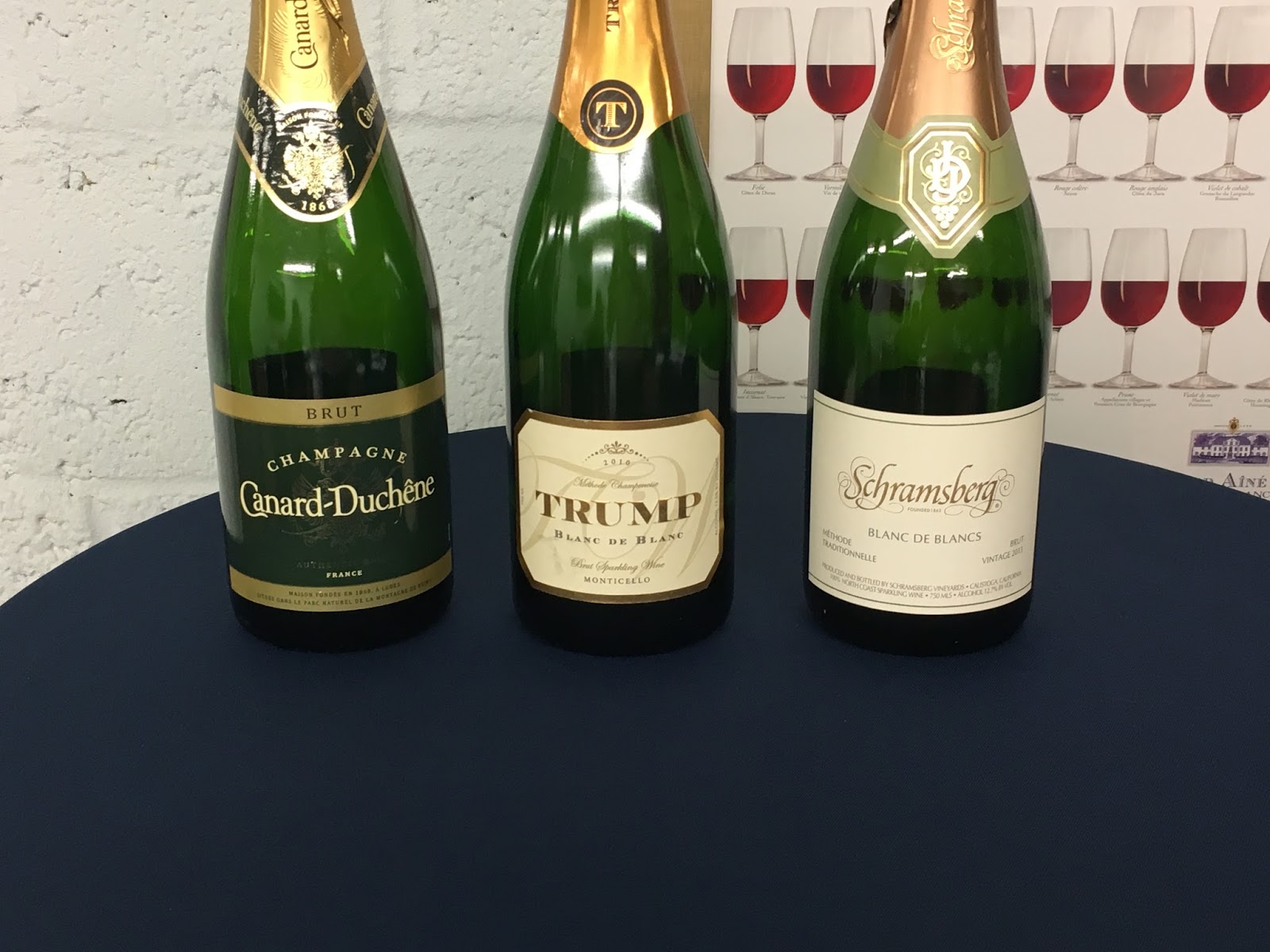
The Trump sparkling wine actually came out as the preferred sparkling wine. It was tasted alongside Schramsberg, one of the most well-respected sparkling producers in California and Canard-Duchene, an authentic French Champagne.
| The sparkling line-up. Trump was a crowd favorite. |
| The red line-up. The Trump red's approval rating was slightly lower than the President's. |
The panel of tasters included both professionals including sommeliers, people who worked in wine stores, distributors, and enthusiasts comprised of casual wine drinkers, aficionados and those who wanted to see how the tasting played out. Of the tasters, slightly more were Democrats than Republicans, and none of the Republicans were supporters of President Trump. Several asked not to be included in photos or videos because they were federal employees or didn't want to be seen as either supporting or opposing the president.
Despite the variance in personalities, professional backgrounds and wine knowledge, the tasting was very civil and even topics of politics were addressed respectfully. Not to draw universal conclusions from an event featuring only a dozen or so people, but it was at least affirming to know that Democrats and Republicans could share the same room and some wine without anybody needing to be rushed to the hospital.
Being the son of liberal Democrats and being married to a traditional Republican (who is ardently not a Trump supporter), the Roman axiom not to mix politics and wine will continue to be enforced during the holidays, but it was refreshing to see what happened during this tasting.
Wednesday, May 31, 2017
Volunteers Needed for a Wine Tasting Next Week!
I am looking for volunteers to help with the extremely difficult task of drinking wine.
This will be for a story that will appear in the Washington Post and for a series of stories that will appear right here on Beltway Bacchus.
The task is to find half a dozen individuals who supported/support Donald Trump and half a dozen people who do not support the president to participate in a wine tasting. The tasting will include wines from Trump Winery as well as other Virginia and California selections.
Tasters will first be asked to taste the wines blind (without seeing the label) and offer their opinions. They will then be asked to taste the wines with the labels showing to see how political bias affects the taste and appreciation of wine.
If you are interested, please let me know. The tasting will be held at Unwined Virginia (1600-A Belle View Blvd. Alexandria, VA 22307) on Tuesday, June 6th at 6.30 pm.
Anyone who is interested, please contact me offline, beltwaybacchus@gmail.com or @BeltwayBacchus and let me know if you are in the pro or anti Trump tasting camp.
This should be a great, insightful and fun tasting. So much so that I am forgoing my usual adage that politics and wine should never be mixed for this one evening.
I know there are some interested people out there, so please let me know!
Tuesday, April 11, 2017
Wine Real Estate: Locations, Locations, Locations
Even without bringing the TTB, three-tier systems and the patchwork of state laws, regulations and statues that pertain to getting wine into the hands of consumers, wine laws around the world are a master course in Byzantine localism, politics and turf warfare. Bordeaux has strict laws over types of grapes, acerage yield, bottling requirements and a slew of other restrictions and regulations designed to make sure that a wine from Bordeaux tastes like... a wine from Bordeaux. Within the strict national laws implemented by the French government, there are regional battles. Margaux and St-Estephe vie for superiority - and since they are so tightly regulated in what they can grow, how they can grow it and how much they can produce - it is a pretty level playing field that comes down to the winemaker's skills, blending proportions and intangibles such as the terrior where the grapes were grown.
God help us all if we try to figure out the clash of clans that occurs over single hectare in Burgundy or the model of disfunction that is Italian wine classification...
This is not just an Old World wine problem either. While it is true that the restrictions on grape varietals, yields, etc., aren't as strict, in an utterly American way, pure economics dictates that certain grape varietals be grown in certain areas. The real estate in Napa Valley is far too expensive to fiddle around with things like Sangiovese, Tempernillo or even Pettit Verdot in anything but limited quantities. Cabernet Sauvignon is what people expect, can reap the highest price and is what people want.
Ditto Syrah/Shiraz from Australia and Malbec from the Mendoza region of Argentina.
Indeed much of the wine world's very educational mastery - and snobbery - comes from people who
have studied - and studied extensively - the nuances of the different wine growing regions, their soils, their histories and their grapes.
So what would happen if these centuries of history, generations of winemaking traditions and decades of government regulation and economic incentives were thrown out the window? What if a winemaker could blend grapes and produce a wine not in the hyper-local tradition that wine is usually made in, but in an national sense? What would a French wine taste like that encompassed both Bordeaux and the Rhone? Could an Italian wine with grapes from both Piemonte and Puglia stand out as truly Italian? Ditto blending different regions of Spain, California or Oregon?
Leave it to winemaking superstar David Phinney of Orin Swift fame to find out. Phinney is well-known for his blends - The Prisoner perhaps being his most well-known and highly-rated. Add high praise from none other than Robert Parker, and you have the possibility of turning centuries of winemaking on its head.
It has hints of cranberry, strawberries and licorice, though lacks the characteristic earthy nose of some regional French wines. Giving the wine some time to breathe did open it up and add complexity to both the bouquet and flavor profile.
The Spanish Locations wine more accurately accomplished what Phinney and his talented team are striving to do: produce a wine indicative of a whole country. With such subtle and specific characteristics in Spanish wines - leather, earth, spice box, dried fruit and chocolate - that permeate the different growing regions, Locations nails it. All the smells I look for in a spanish wine were accounted for, all the flavors were accounted for, and the lingering aftertaste lasted just long enough for the wine to be memorable. It also did have a jammier mouthfeel than most Spanish wines, but that is forgiven based on all the other positive attributes.
Leave it to winemaking superstar David Phinney of Orin Swift fame to find out. Phinney is well-known for his blends - The Prisoner perhaps being his most well-known and highly-rated. Add high praise from none other than Robert Parker, and you have the possibility of turning centuries of winemaking on its head.
That, at least, is what Phinney's new project Locations Wines aims to do. Thus far, I have tried the French and Spain blends. The French wine is a light to medium bodied red comprised of Grenache, Syrah and Bordeaux varietals from the Rhone, Rousssillon and Bordeaux.
| France in a bottle. |
The Spanish Locations wine more accurately accomplished what Phinney and his talented team are striving to do: produce a wine indicative of a whole country. With such subtle and specific characteristics in Spanish wines - leather, earth, spice box, dried fruit and chocolate - that permeate the different growing regions, Locations nails it. All the smells I look for in a spanish wine were accounted for, all the flavors were accounted for, and the lingering aftertaste lasted just long enough for the wine to be memorable. It also did have a jammier mouthfeel than most Spanish wines, but that is forgiven based on all the other positive attributes.
| A Spanish wine battling the windmills of winemaking tradition, laws and customs. |
There are some other Locations wines I look forward to trying in the near future. The press materials for Locations Wines says that the driving force is to make wines that are Simple, Complex and Fun. The French wine was more on the "simple" side and the Spanish one was more on the "complex" side. Both were "fun" insomuch as I enjoyed drinking them. If Locations wines does aim to upend how wine is made, taught and enjoyed, then it certainly has its work cut out for itself. Still, there is something satisfying about trying something new - especially if it results in wines like these.
Wednesday, March 8, 2017
A Quick Observation on Virginia Wine
I have been away from writing about wine in general and Virginia wine in particular for a couple of years... Having two kids will do that to you. Not that you drink less wine, per se, just that you don't drink and appreciate wine like you can in pre-kid days. Now its more a race to finish a glass before falling asleep on the couch. My wife is a lucky woman, isn't she?
Now that I have picked the blog back up, what has been astonishing is the amount of quality wine and quality coverage coming out of Virginia. Just a few years ago, it seems, Virginia wine was a quirky local interest product at most wine stores - usually relegated to the back next to the jugs our up front next to the impulse buys.
In these short years, however, Virginia wine has taken a spot among the more respectable wines from around the world. True, we are its home base, but go into any wine store in the DMV region and you will find a pretty prominent display of wines from Virginia. The closest wine shops to me - Red, White and Bleu, Swirl & Sip, UnWined and even Total Wine have all dedicated valuable shelf space to expanding their Virginia wine offerings. Whether this is a case of marketing, wanting to introduce Virginia wine to their customers, or consumer-driven demand, I don't know. But in a few short years, there has definately been a trend to offering more wines from Virginia - from multiple regions.
From a press perspective, Virginia wines continue to hold their own. Outside of the local press and coverage of the Governor's Cup, Forbes, the Wall Street Journal and Food and Wine have all written very favorable articles in the last few months about Virginia Wines.
It's actually remarkable how far the industry has come since I was last paying attention to it. Wineries in Virginia now top $1 billion dollars in sales, attract over 2 million visitors and Virginia is now the fifth largest wine producing state in the country. Demand is growing and the quality of the wine continues to improve. Even in such highly charged, politically contentious times, it seems like everyone can agree that Virginia wine is having a much-deserved moment.
Subscribe to:
Comments (Atom)